Showing posts with label Boardgames. Show all posts

Tuesday, July 19, 2011

Let's Talk Boardgames: Settlers of Catan

Image from www.amazon.com


Settlers for me is like that one band you discovered in high school that no one else had heard of. Then all of a sudden everyone got into it and now they're not cool anymore. I discovered Settlers when my college roommate brought it back from Germany. We played it in German (with none of us speaking German except my roommate) and due to the game's simplicity, had no problems learning and playing.

Then it seemed like EVERYONE knew about Settlers and it started appearing in English. I started to lose interest mostly due to burnout. However, I also consider it to be my first hipster moment. Recently however, I've started to rediscover what it is that makes this game so popular.

Gameplay is simple yet strategically deep. The board is a random set of hexagons, each representing a particular resource. Numbers between 2-12 are assigned to each so the board is different every time you play. The objective is to obtain 10 victory points before anyone else (expansions raise this to 12). You gain points by building settlements, cities and roads. On a roll of a 7, the robber can shut down a tile and steal resources.

Trading resources is an encouraged, and certainly necessary part of the game. Resources can then spent to expand, or upgrade your settlements into cities. You can also purchase development cards which allow you to bump the robber, give you free roads or other improvements.

The rules are very simple. I was able to learn despite all the components being in German. This is a game you can get your non-gamer friends to play. There are three expansions for the game: Seafarers, Cities and Knights, and Traders and Barbarians. Each adds a new level of play. In Seafarers, most of the board is unknown and is revealed as you explore. In Cities and Knights, you must defend Catan against barbarians while improving your cities internally. I have not played Traders and Barbarians, but it allows movement on roads and various other scenarios.

The game supports 4 players, but also has a 5-6 player expansion (you'll need one for each further expansion, so it does get a bit pricey). For your first expansion I'd recommend Cities and Knights. Seafarers is good but Cities and Knights has a lot more depth. Learning this game is much less intimidating than Agricola or Dominion. If you've never played a Euro-style game before, this is a great place to start.

Monday, July 26, 2010

Let's Talk Boardgames: Ticket To Ride


For today's installment, I'll be talking about the most recent addition to my collection, Ticket To Ride. I own the Europe version, but I've also played the American one. There is a Märklin and Nordic Countries version as well, but I haven't played those.

The objective is to earn the most points by the end of the game. You earn points by completing destination tickets (a route from one city to another, there's a deck of cards so they're like quests) and by building lines from city to city. The longer the route/line the more points it is worth. Once a line is filled, no one else can take it so the strategy comes in choosing which routes to build and getting the priority lines first. There's also bonus points for whoever has the longest total route.

You build routes by using train cards, which you can draw. The Europe version has ferries and tunnels which make building lines rather tricky in some areas, especially around Switzerland. That's pretty much all there is to it. The game is about making choices with a bit of luck thrown in which cards you draw, though five are always face up so you do have some choice in the matter.

As for the American version versus the European version, it's really a matter of personal preference. The American map is more open and the gameplay is more simple while the Europe version gets rather crowded in western Europe, and the tunnels and ferries can make building a bit difficult at times. I like looking at the European map and seeing the names in their original languages, as they were in 1910 (the year the game takes place). I also like the added challenge of the tunnels and ferries, and if you want you can ignore those extra rules. The game plays just fine without them. There's also rules for Stations, which help you connect your routes so you don't lose points on them, especially when western Europe gets crowded.

This game is great for your non-gamer friends and family. While games like Dominion and Agricola are off-putting to my wife she loves to play Ticket To Ride. The gameplay is simple to learn but with enough challenge for seasoned veterans.

Finally, here's my ultimate strategy tip. Look at the destination tickets you are dealt, and find which ones you can complete together with the least amount of effort. Don't try and make your line like a snake, make it like a hydra, a long body to connect distant routes but with many heads to get as many cities as possible for your route cards.

Friday, May 7, 2010

Let's Talk Boardgames: Killer Bunnies and the Quest for the Magic Carrot

Could the title be any longer? For this month's installment I thought I'd talk about one of the...odder selections in my board game collection. It's not actually a board game but a card game. A card game with loads of expansions. I'll get to that.

Gameplay:

To start off, you draw a hand of seven and lay down two cards. These two cards function like a conveyer belt, and every turn you play the top card so you must plan your game two turns in advance. In order to win you must have the Magic Carrot. There are two carrot decks, one of which is shuffled and laid face down pre-game, the bottom card being the magic carrot. You can buy carrots during the game, or win and steal them. Players who don't have a lot of carrots still have a chance of winning through this draw, though you must have a bunny to win.

There are a variety of cards to play. Some are bunny cards, you need one to win and they tend to die rather quickly. With later expansions you find yourself with more resilient and powerful bunnies. Other cards are attack cards, which range from a level one spatula to a level twelve nuke. There are virus cards which spread, specials which let you gamble your property or steal your opponent's property, along with other shenanigans, monkeyshines, and high-jinks. Most of these cards require you to have a bunny in play so keep them alive!

Pros:

The cards are rather silly. Attack cards range from a wire whisk (level 1) to nukes (level 12 and can destroy nearby bunnies) to even more ridiculous weapons. The artwork and cards frequently reference classic sci-fi franchises such as Red Dwarf and Star Trek. The creators have invented many, many horrible ways for your bunnies to die. The game certainly does not take itself seriously.

Gameplay is fairly simple in the beginning. The rules are easy to learn with the starter set. You're allowed to trade with other players which can lead to hilarious negotiations and impromptu alliances. Don't expect them to last though, they are frequently shattered when you are betrayed.

Cons:

A large chunk of cards require you to have a bunny in play in order to use the card. If you don't start with a bunny it can be discouraging to not be able to do anything until one shows up. I played one game where a player didn't draw a single bunny for the whole game. I have also had times where I finally got a bunny out only to have it killed seconds later.

There are a large number of expansions for this game. They are individually cheap but to get all of them is a sizable investment. Each one adds a new level of complexity to the game which is fun for experienced players but it makes it near impossible to introduce the game to new players in this expanded state. You then have to sort out all your cards in order to teach a new player the game unless you want to explain a lot of stuff.

Conclusion:

If I can use a 40k analogy, this game is not for the Competitive Gamer, but is the kind for the Fluffy Bunny. It's near impossible to set up a game winning strategy, a large chunk of the game is luck of the draw. Strategy mostly comes in your personal interactions; do you play it safe and be everyone's friend, or do you join in picking on the leader? A Competitive Gamer would get frustrated with the reduced amount of control while a Fluffy Bunny would enjoy the silly cards and situations, along with the personal interactions.

It also greatly depends on your group. I've played the game with lame groups and it was less fun, while with certain people the game is hilarious. I have fun with it- and I also enjoy high strategy games like Agricola and Dominion. This game really depends on your group. This is one of those "gateway games" that help introduce people to board games other than Monopoly.

Monday, March 15, 2010

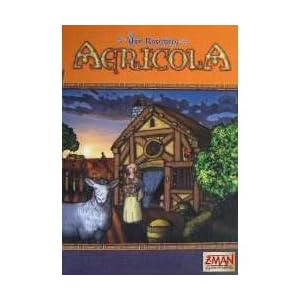
Let's Talk Boardgames: Agricola

image from www.amazon.com

Agricola is a strategy game that I rank as one of the more challenging games in my collection. What makes this game so challenging is that there is no player-dependent random chance in the game (until you introduce the occupation and improvement cards, but more on that later). The game is entirely about choices that you and others make.

The objective is to expand your 17th century farm to attain victory points, all the while making sure your family is fed. You start the game with two actions (representing your farmer and his/her spouse). Later you can expand your family to get more actions, but now you've got more mouths to feed. Actions include gathering wood, clay or stone. With those resources you can expand and renovate your house and fields. With other actions you can raise animals, plow, sow, and bake your hard-earned grain into bread.

None of the actions are better than any other. The rest of the game is determined by the choices you and your friends make. There's no "attack" actions, the only way to stop a player is to simply take the action they wanted. This can get annoying if it's clear what you want, but a good player will have several possible courses of action.

Now I said that there's no random chance; that's not entirely true. When the game begins you set up 14 action cards for the 14 rounds. Every round there's a new card. These vary in order so that no two games are the same, but since the setup is the same for every player that doesn't really count as chance. It can affect your strategy, however.

The second aspect of random chance is in the improvement and occupation cards. These cards are fully optional. In fact, I'd recommend that new players hold off on the cards until they grasp the rules completely. Each player is dealt 7 from each deck at the beginning of the game. These cards can improve your efficiency in key areas. While these cards are random, you only get them at the beginning and none of them (well, hardly any) are game-breaking. Even the ones that are a bit more powerful still require a series of choices in order to claim them. I have seen players spend several turns trying to meet the conditions of certain cards, only to neglect other aspects of their farms. I have also won games with no cards, while others had far more useful cards simply because I made better choices. In my opinion, the cards add another layer of depth to the game. It's a bad strategy to try and use every card in your hand. I usually pick one or two that coincide with my plan.

Agricola is not a terribly casual-friendly game. It has complex rules and the choices can be completely overwhelming to new players, especially when you add in the cards. However, those looking for a deep strategy game without the luck factor will enjoy this game. It is a bit pricey but you'll be getting years of enjoyment out of this game.

Friday, February 5, 2010

Let's Talk Boardgames: Dominion: Intrigue

Enough colons in the title? Last edition of this feature talked about Dominion, so this time we'll discuss its stand-alone expansion, Dominion: Intrigue.


The basic gameplay remains the same for Intrigue, so if you missed it, check out my first review. Assuming you've read that, let's proceed with the expansion.

The cards are all fully compatible. You can mix and match the sets as you please. I have yet to try mixing the two sets, but should you get tired of either one mixing them up would bring new life to the game as it opens up new combos.

Where Intrigue stands better than its predecessor is in the interactivity. As I mentioned before, the biggest problem with the first game is that most games end up running down the same route, and it ends when someone purchases the last province card. In Intrigue, I haven't had that happen yet. Mostly, we run out of other cards first because the strategies are so radically different.

In addition, the cards are much more interactive. This helps more than anything in getting non-gamers to play and enjoy the game. Some of the attack cards are downright nasty, and provide that "screw you" factor that some people enjoy. Since none of the attacks are targeted, you can still screw over your friends without anyone feeling picked on. While many hardcore fans saw this as a drawback, I see it as an advantage. This forces you to change your game and adopt new strategies instead of the same old boring Province decks.

One other area that stands out is the dual-purpose cards. In standard Dominion, money and other cards do nothing for you at the end of the game, while during the game your hand can become clogged with victory cards which do nothing until the end of the game. In Intrigue, several cards have uses beyond victory. For example, one card is both and action and victory card. Another is money and victory. Yet others enhance the value of other victory cards. These cards vary the strategy as they can be more valuable than the Province (though the Province is still worth the most victory points).

This is a stand-alone expansion, unlike Sesaside and the upcoming Alchemy, so you can start with this set. I would recommend doing so, as I have had much more fun with this version than the first, and that's saying something. It is easy to learn (I taught my 9-year-old nephew) but difficult to master. No two play-throughs will be the same as there's the same wide selection of cards as in the first game.

Next time I write this, I'll be looking at some other favorite games of mine. Stay tuned!

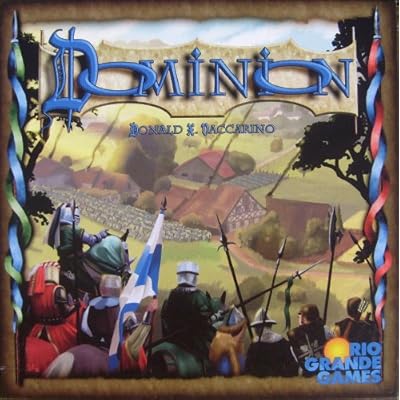
Image taken from www.amazon.com

Tuesday, January 5, 2010

Let's Talk Boardgames: Dominion

In a non-40k feature, I'd like to review some of the board games that I play. The first up for review is Dominion.

Dominion is a card game in which you seek to build up your kingdom through your choices. All players begin with the same cards, the choices you make in your first and subsequent turns will ensure that everyone takes a different strategy.

In the game there are resource cards, victory card and action cards. Every game has the same resource cards, but different action cards. The set comes with 25 action cards, and you only use ten per game. That's quite a lot of different combinations.

The action cards are the heart of the game. If you played Magic: The Gathering, consider the resource your lands and the actions your creatures and spells. Of course, actions don't win you the game. In order to win you need to have victory cards. These victory cards do nothing for you during the game (except for in the expansion, more on that later) but are the only things that count at the end of the game. So the objective is not to get the thickest deck imaginable (though there is a card for that) but to balance resources, victory and actions.

The rules are fairly simple and the strategy is deep. There's luck involved but building your deck properly will keep the luck factor to a minimum. The games play in about 30 minutes and creates the "just one more game" feeling.

There are no direct attack cards. There are cards that affect other players, but when such exist they affect all other players. This way no one feels singled out. There are also ways to defend yourself. Attack cards don't deal damage or kick you out of the game, they generally consist of messing with your hand or giving you negative cards. Of course, a relentlessly attacking player might be neglecting his victory building...

Dominion can appeal to the non-gamer as much as the gamer. My wife plays it and enjoys it, though I think for introducing this game Dominion: Intrigue (the expansion) is a better introduction. Intrigue is far more interactive, but I'll cover that in another review. But therein lies one of Dominion's flaws: too many games just end up with four people playing solitaire together. Dominion technically has multiple victory routes, but most games end up going down the same path. The expansions Intrigue and Seaside (I have not played Seaside but I have seen the cards) fix this problem, as my games of Intrigue have all gone extremely differently, far more so than Dominion.

I highly recommend this game. As a former Magic player, this game gives me that same fix but much cheaper. It's deep enough for hardcore gamers and accessible enough for non-gamers. There's plenty of replayability as you only use 2/5 of the action cards that come with it per game (plus you can mix and match expansions for even more variety).

Next time I do this, I'll review the expansion, Intrigue.

Related Posts:

Related Posts with Thumbnails